A First in Turkey: Traces of Resilience in the Brain to be Investigated
.
In the project titled "Neurophysiological Markers of Individual and Collective Resilience," conducted at our university and bringing together psychologists, sociologists, and computer engineers, the individual and collective effects of resilience will be examined, and an electrical map of the brain will be created.
Associate Professor Dr. Seher Akdeniz, Director of our University's Trauma Research and Application Center, stated, "With this project, we aim to identify what works best for individuals, particularly in enhancing psychological and social resilience, and to transform these findings into various programs that benefit society." The "Neurophysiological Markers of Individual and Collective Resilience" project, described as a first in Türkiye, will analyze individuals' post-traumatic resilience processes using data. The study will also evaluate the effects of social and community resilience on human psychology. The project, involving various academics, aims to contribute to scientific research in the field of psychology with the data obtained.
"We Focused on Research at the Neurological Level for the First Time"
Stating that psychological resilience refers to an individual's capacity for recovery and flexibility in the face of challenging life events, stress, and trauma, the Director of our University's Trauma Research and Application Center, Assoc. Prof. Dr. Seher Akdeniz stated, "In the literature, it is generally measured with self-knowledge scales. Here, we aim to support this with concrete biomarkers. We focused particularly on understanding, at an interdisciplinary level, what we call post-traumatic growth, how individuals emerge stronger from difficulties. However, humans are social beings. In times of crisis, they unite with a sense of shared destiny, and individuals who believe in the strength of their group and society can find greater strength within themselves. In this research, we focused on investigating, to our knowledge, for the first time at the neurological level, whether social resilience creates a protective armor against stress in our brains. Data was collected from thousands of people, and here we selected individuals according to specific algorithms. We applied many scales, including psychological resilience, social resilience, empathy, and emotion regulation. We invited individuals who met our target algorithms in these scales, such as coping styles, here for neurophysiological measurements, including EEG and eye-tracking device measurements. Our goal here is to identify what works best for individuals in terms of increasing psychological and social resilience and to integrate these into various programs for societal benefit." "We aim to transform it," he said.
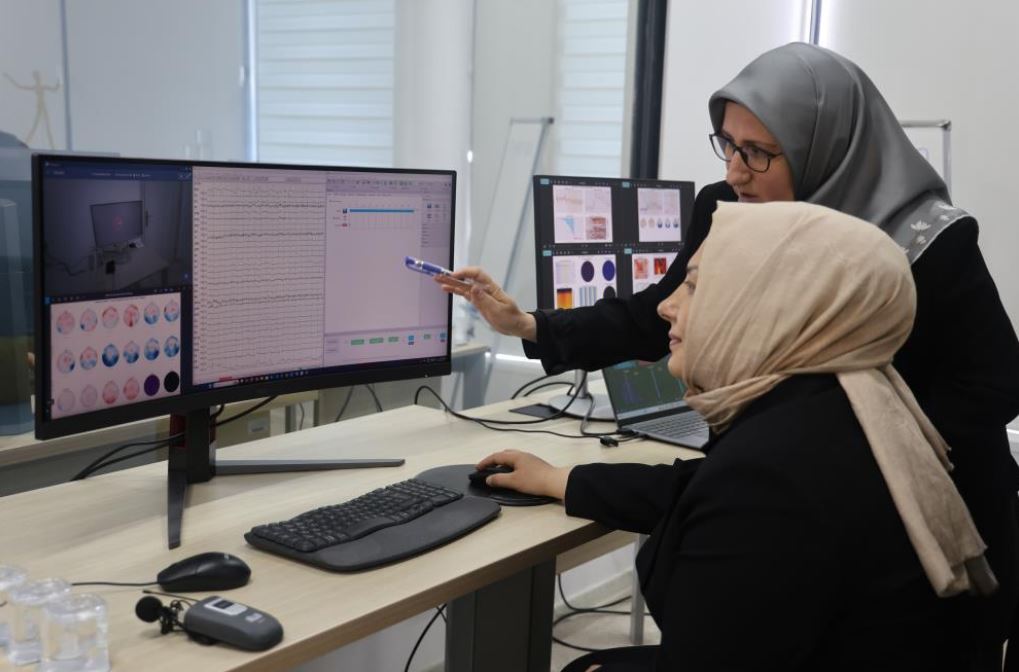
Dr. Ayşe Merve Acılar, Assistant Professor in the Department of Computer Engineering at our university and Deputy Director of TRAUM, stated: "Within the framework of this experiment, we obtain images from both EEG recordings and eye-tracking from our participants. Subsequently, these recordings become the raw recordings we receive. We clean the EEG recordings using signal processing methods. We also mark the recordings from the eye-tracking device and take the appropriate frames. Our aim here is to create a dataset for machine learning methods and to find biomarkers specific to an individual's resilience using machine learning methods. Using these biomarkers, we can develop AI-supported applications that can be used as decision support systems in programs that can be developed in the field of psychology in the future. Artificial intelligence is a very broad concept; we are interested in its algorithmic aspect. We call them machine learning algorithms. Here, we are talking about algorithms that learn from data. These are algorithms obtained based on classical statistical methods, but we are taking advantage of the benefits offered to us by the developing technology to delve a little deeper and discover the unseen." We would like to thank İhlas News Agency and İbrahim Yetkin.